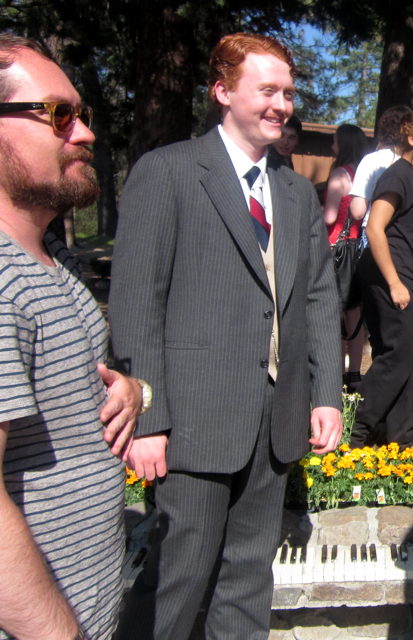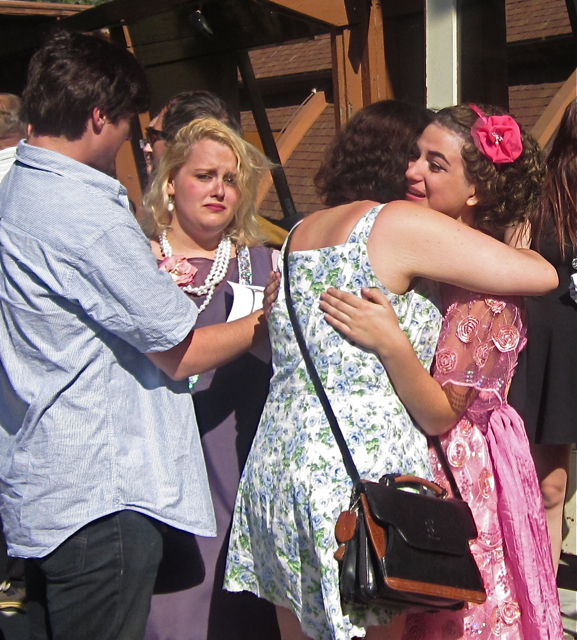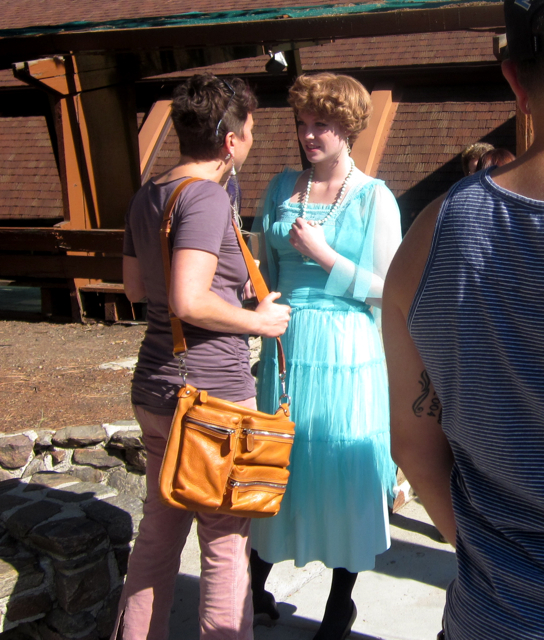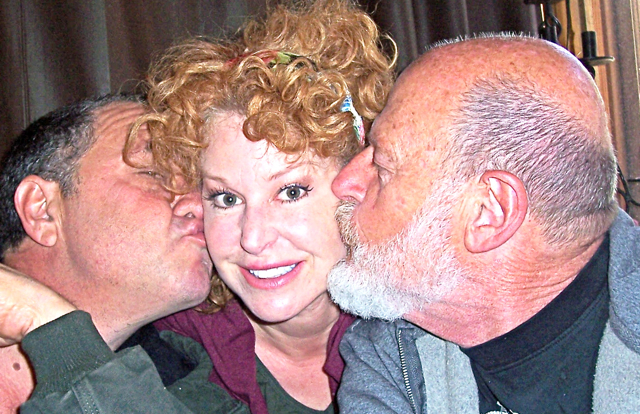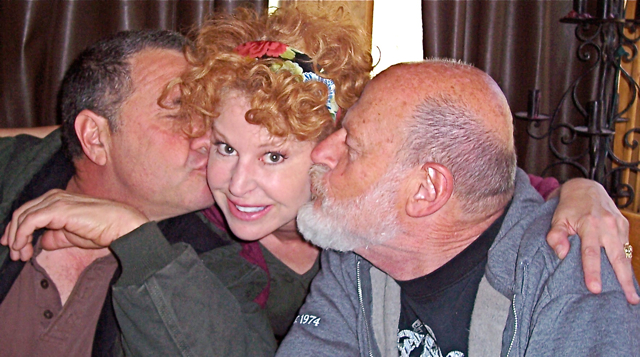
(from L) Vic Sirkin, Betty Anderson and Lou Bacher play one murderous trio
By Marcia E. Gawecki
If you do anything in Idyllwild this Memorial Weekend, go see the final show of “Murder at the Howard Johnson’s.” It’s a fast-paced comedy about a love triangle between a married couple and their dentist. It promises an evening full of old fashioned belly laughs. The last show is at 7 p.m. Monday night.
“This is not high art,” quipped Connor O’Farrell, the show’s director. “Good plays have layers and depth, but this one just offers joke after joke.”
“Murder at the Howard Johnson’s” is about trouble in relationships. Anyone who has been married or has been in a relationship can relate, and laugh at themselves,” adds Conor.
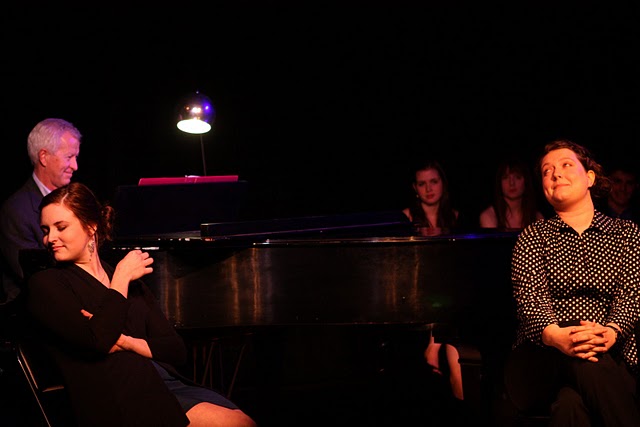
As it turns out, Conor and his wife, Holly O’Farrell, both performed in the first act of Sunday night’s show.
As Doug Austin, the Master of Ceremonies, explained: “Murder at the Howard Johnson’s” will be portrayed in three acts, with nine players, all in similar costumes.”
“The reason we’re using nine actors is because so many talented actors showed up at the auditions, and we couldn’t turn them away,” Doug said. “Actually, last year, everyone kept forgetting their lines, so we had to split it up!”

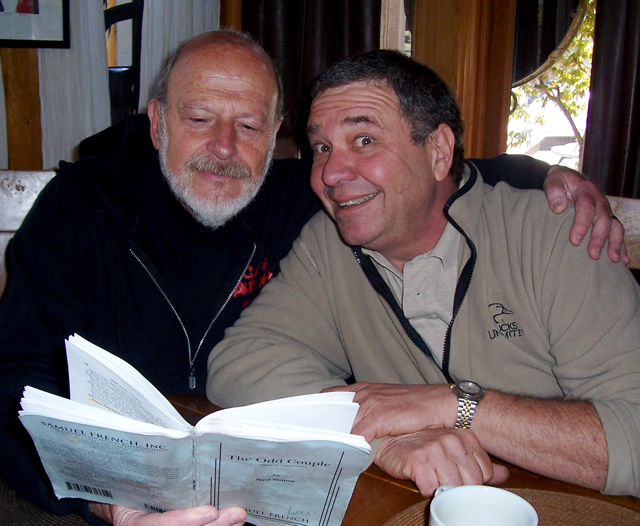
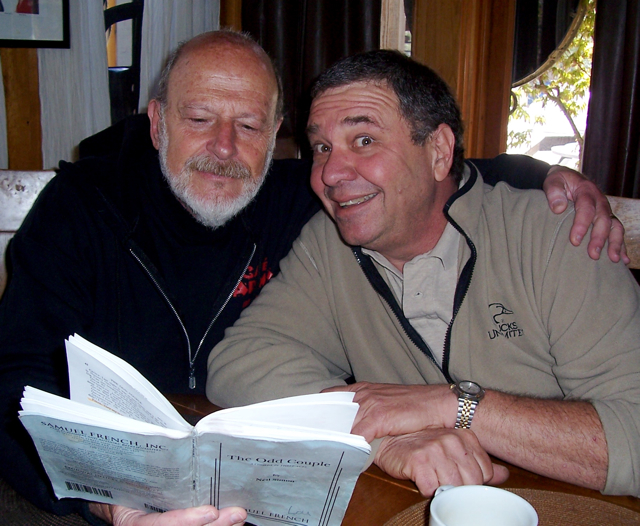
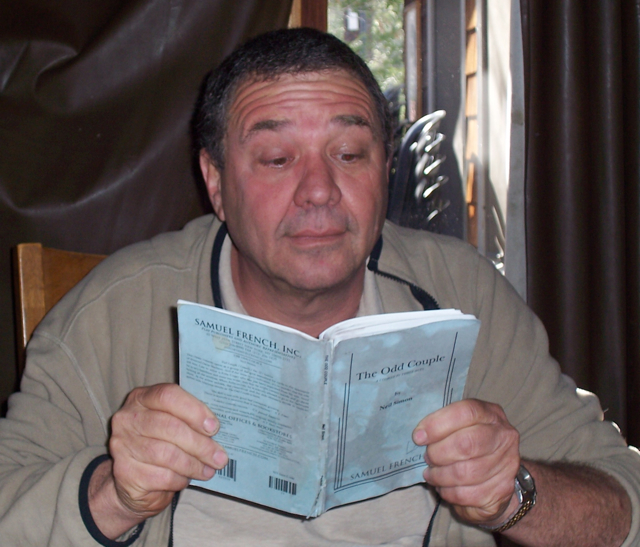
(from L) Last year's show featured Lou Bacher and Vic Sirkin as the "Odd Couple"
Doug’s reference was to last year’s comedy, the “Odd Couple” starring Vic Sirkin and Lou Bacher, two locals, who had to memorize 600 lines of dialog each. During their performances, they had their scripts on their laps and were calling for lines, Conor explained.
“Every now and then, they’d get this ‘deer in the headlights’ look, wait about five seconds, and then deliver their lines,” Conor recalled.
During Sunday’s performance, there were only two of those “deer” moments, but they recovered quickly and the audience laughed along with them.
“You end up memorizing the whole play, really,” explained Lou Bacher, president of the Idyllwild Help Center, who also plays one of the dentists.
“If Vic doesn’t give me the right line, I’m screwed,” Lou explained. “I don’t know where to go next. So you end up memorizing their lead-in lines, your lines, and basically the whole show.”
That’s a big bill for a man in his 70s, but someone has to do it.
Sunday night’s show could have been a bust because of the weather. It had been raining all day, with no sign of letting up at showtime. Yet, those hearty folks with tickets ate their spaghetti dinner in their laps, and didn’t complain about eating ice cream and cookies in chilly weather.
“Even if they cancelled the dinner, it wouldn’t matter,” said one part-timer from Carlsbad. “All of the proceeds go to the Help Center.”
Sunday night’s show was the third performance for the acting troupe with their final show tonight, Monday, May 30, at 7 p.m.
Ticket sales were going well. Before the show, Steve Taylor, a board member, said that they had already achieved $13,000 of their $15,000 goal. After the show, Lou said it was even higher at $14,000.

Lou Bacher, actor and board president, said the Help Center reached $14,000 by Sunday night
When I heard that nine actors would be playing three people in the same outfits and wigs, I was skeptical. But since there was only three characters in each act, it was easy to follow.
“I’m the only natural curly-headed redhead, so I don’t have to wear a wig,” claimed Betty Anderson, an Idyllwild newcomer with musical theater experience.
Speaking of wigs, the ones worn by the gigolo dentist were so cheesy that it was painful to watch. That shaggy, 70s Peter Frampton style wig was so ill-fitted and ridiculous on all three dentists.
Yet, it was the snappy dialog that carried this play. Written by Ron Clark and Sam Bobrick, it reminded me of those wonderful Neil Simon comedies set in New York. You’re just laughing and reacting to the first joke, when they’re onto the next one.
Conor, who plays Paul, the husband in the first act set on Christmas, is surprised to see his wife and dentist in the same room at the Howard Johnson’s hotel. Their affair surprises him, yet he has no idea about their dark and dubious plan.
“Didn’t I satisfy you sexually?” Paul asks Arlene, ignoring Mitchell (played by Frank Ferro, the dentist with the bad wig).
“A marriage is like baseball,” Paul explained. “Sometimes you pitch, sometimes you catch. Sometimes it goes into extra innings, and sometimes it’s rained out. But you love the game, so you’re in for the long haul.”
Arlene (played by Holly O’Farrell, his real-life wife), would hear none of that. She wanted sex, freedom and excitement. Nothing Paul, the hardworking husband and weekend couch potato, had to offer.
Yet, the banter between husband and wife, as they sort things out, is precious.
“Wait until you see how cleverly we planned this,” Arlene brags to her husband as they’re tying him up.
Later, she worries that he’ll catch a cold in the bathtub water before they drown him.
The second act is in the same hotel room six months later on the Fourth of July. Exit Conor, Holly and Frank Ferro. Enter a new trio comprised of Phil Drell as the dentist, Chris Singer as Arlene and Pete Caparelli as the husband.

Many Idyllwild homes are decked out for Memorial Day weekend
The wigs, costumes and dialog works. The audience is laughing out loud.
“It was a great way to handle the show,” said Trish, a local, who is also an actress with the Isis Theater Company. “That way, the actors don’t have to recite so much dialog, and no one gets bored.”
Trish went on to say that she liked the show’s reference to locals like Elaine Bacher and the Town Crier newspaper.
“We should do that with the Isis Theater,” Trish said. “It’s a great way to connect with a local audience.”
In the audience Sunday night were some actor’s own fan clubs. The group of five women sitting ahead and next to me came to see Chris Singer in a curly red wig. They were staying at her Silver Pines Lodge and laughed at every joke, except for a few by the show’s MC, Doug Austin.
“Did he really say that?” one of the women asked. “I thought this was a family show!”
For the second act set on the Fourth of July, Arlene used a ploy to get her husband and lover into the same room. Yet, clearly hadn’t figured out her loyalties. Both men longed for her, out of habit and lust. Her hardworking husband lacked excitement, yet her lover lacked his earning power.
What surprised me was both men were willing to resort to murder to keep this ditzy redhead. Conor said to take this show at face value, but you just wanted to shake those two men into reason! Yet, both blamed popular culture (namely newspaper and magazine articles) as the culprit for Arlene’s dissatisfaction with their flawed relationships.
Yet, Arlene didn’t appear to be the “evolved” woman she claimed to be. Like a bee, she’d flit from man to man, still trying to “find” herself.
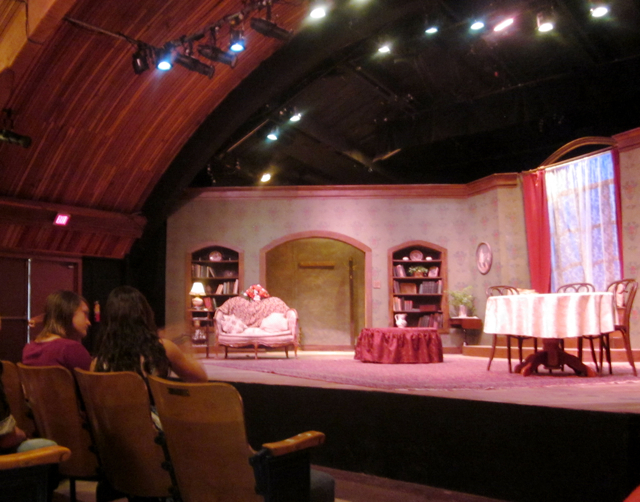
The final trio, comprised of Lou as the dentist/lover, Vic as the husband and Betty Anderson as Arlene, appear in the same hotel room on New Year’s Eve. As a group, they’ve been through a lot together.
When Arlene and Paul attempt to murder Mitchell, he tries to wiggle out with his so-called sincerity. He opens the window and shouts, “Hey world! I love Mrs. Paul Miller!”
“I think he means it, honey,” Arlene says to her husband. “He needs an apology.”
The audience knows that “Mrs. Paul Miller,” is a trophy between two sparring men, but not a true declaration of love.
Besides snappy dialog, audience members can expect lots of physical comedy, such as jumping on beds and walking on skyscraper ledges. All are done exceedingly well with minimal props.
Was one acting trio better than another? You be the judge. As a cohesive play, it worked. The actors weren’t taxed out in rehearsals, yet the audience wasn’t bored.
Yet, it didn’t take a local to follow along.
Charlie and Linda, a couple from San Diego, were visiting Idyllwild Memorial Weekend. They heard about the play at their hotel, and decided to give it a try. Years ago, their son had attended Idyllwild Arts Academy.
From the back row, they laughed along heartily with everyone else.
“We just love local theater,” Charlie said. “This was a lot of fun!”
“I have two rules to live by,” Mitchell (played by Lou Bacher) explained. “No lipstick and no personal checks.”
Yet, seeing Lou in red lipstick sporting a Peter Frampton wig is well worth the $35 ticket price.
The show is MC’d by Doug Austin who tells corny jokes, but keeps the auction items going. A weekday getaway at Silver Pines Lodge (for two) garnered $150, while two photos of Frank Ferro (fully clothed in 70s attire) brought in another $50 or so.
By tonight’s show, (Monday, May 30th) it looks like the troupe will surpass their $15,000 goal. Which is a pretty incredible feat given our tough economy.
“We’re serving customers at the Help Center now who once donated to us,” Lou said pointedly after Sunday night’s show.
Besides the Mary Austin Scholarship Fund, the show had help from Sysco Foods, Cafe Aroma, Community Lumber, Isis Theater Company, John Simpson for graphic design, Linda Anderson for spearheading the meal and all of the Help Center volunteers.
Tickets to tonight’s show (Monday, May 30) are still available. Get them at the Help Center, Silver Pines Lodge or by calling (951) 659-4335. Dinner will be held from 5 p.m. to 6:30 p.m. Show starts promptly at 7 p.m.
Copyright 2011 Idyllwild Me. All rights reserved.