Archive for the ‘Nature’ Category

Are Bark Beetles Back?

Tuesday, August 10th, 2010

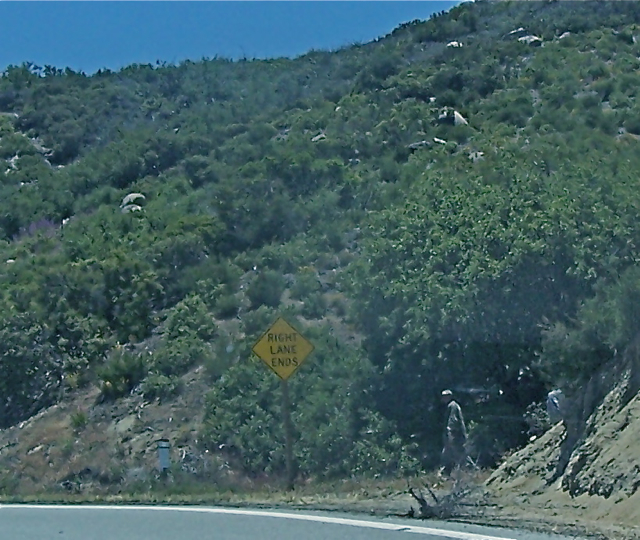
A dying fir tree along Hwy. 243. Bark beetles may be the culprit.

Driving up Hwy. 243 from Banning, you can see brown trees in the distance, where before there were only green ones. We had plenty of moisture in the spring, but now there are entire trees turning brown along the road side. Brown is a color that is too bold to ignore. Are the bark beetles back? Is Idyllwild going to lose thousands of trees like it did in 2003?

“It’s a natural process,” said Laura Verdugo, a visitors services information assistant, at the Idyllwild Ranger Station. “Trees die in the forest all the time from overcrowding or drought, but I don’t think what you’re seeing here is anything like what happened here in 2003.”

It's likely a Western Pine Beetle if the tree is dying halfway up (shown)

However, once she saw pictures of one tree that was brown in the middle, but green on top, she said that it could be a bark beetle causing its death. She motioned to a “Meet the Beetles” book on a nearby display.

“It’s for kids, but explains bark beetles pretty well,” Verdugo said.

The brightly-illustrated book only had five pages, but it was a wealth of information, even for adults.  For example, there are four different types of bark beetles in these parts, each with a different MO and preference for pines.

The four beetles covered in the book include: the pine engraver beetle, the red turpentine beetle, the western pine beetle and the jeffrey pine beetle. They show a close-up of the beetle, next to a tree that also shows the beetle’s markings.

The book is written for young adults with zippy language. Here’s an example of the red turpentine beetle:

Favorite food: Ponderosa Pine

Measurements: 3/8 inch at adulthood

Reddish pitch tubes left over on bark by a Red Turpentine Beetle

Colors: reddish brown

“I was here” tag: Reddish pitch tubes (small wads of resin on the tree trunk)

Special skill: Capable of flying more than 10 miles

After reading one particular page, Verdugo said that it looked like it was the Western Pine Beetle that was likely killing the Coulter Pines along Hwy. 243. This beetle’s “attack position” is usually midway up the tree trunk.

It’s “worst nightmares” (or predators) are  woodpeckers and checkered beetles, the book said.

The book shows a close-up of the bark beetle and the markings it leaves on the trees

“I didn’t know that certain beetles ate each other,” Verdugo said.

She added that many locals and visitors bring in bark beetles to the Ranger Station, to help identify them.

“But most of the beetles they bring in aren’t bark beetles,” she said. “They’re way too big. You can see them from across the room.”

More and more brown trees are appearing along Hwy. 243

She explained that bark beetles are incredibly small, measuring 1/8 to 3/8 of an inch.

“The beetle pictures are nice, but they should have put a beetle in its actual size,” she added.

Verdugo said that one of the employees at the Ranger Station put the book together, but she wasn’t sure if it was available online.

IN RELATED NEWS:

On Tuesday morning, August 10, there was road construction along Hwy. 243 from Idyllwild towards Banning near the Silent Valley Club. The highway is restricted to one lane, with an “escort” truck. There is a modest wait (about 15 minutes).

Several bulldozers and trucks are creating a new pullout space, and smoothing the road’s edge. If you plan on going down to Banning or Palm Springs today, you might consider adding some extra driving time.

Custom Search

Sherman, the horse on Hwy. 243, is OK

Saturday, July 17th, 2010

Sherman, the horse on Hwy. 243 is just fine, says Joyce, his owner

Like hundreds of others before me, I was worried about the horse standing in the hot sun. Did he have enough water? And there was no shade trees around him, next to Hwy. 243. It must’ve been 90 degrees out there. I must help him!

So I ran home, got a bucket of water, and some carrots from the fridge, and drove back. I shimmied under the barbed wire fence, and gave him the bucket. Next to his massive head, it looked like a little Dixie cup. He immediately picked it up and dumped out the water!

I gave him a few carrots, and was searching for a hose to fill the bucket again, when the owner walked up.

“Can I help you?” she asked. Which is very polite for someone messing with their horse on their property. The barbed wire fence should have been a clue.

“Oh, I was just trying to get some water for your horse,” I stammered.

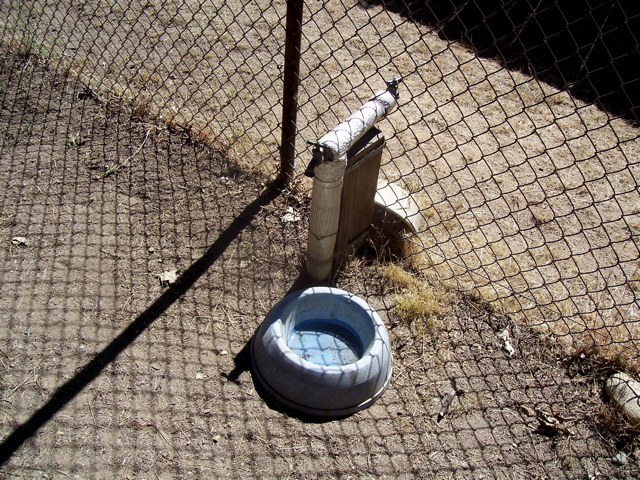
“Well, the fountain that you’re pushing on is the same one he uses to get water,” Joyce Miller explained. “He just pushes this lever with his nose, and he can get as much water as he wants.”

Sherman's water fountain releases water when he pushes it with his nose

As it turns out, I am not alone in my concern for “Sherman,” the quarter horse. In any given weekend, at least three people will come up and ask about the horse. Their main concerns are: There is no shade and no water for the horse.

“When we lost that oak tree two years ago, then more people began stopping by, concerned,” Joyce said.

At least three of them have reported the Millers to Riverside County Animal Control.

“They have to come all the way from Riverside to see that Sherman is OK,” Joyce said.

She’s gone through two inspections, and one time they left a note of approval. First, they inspect the horse to make sure he’s not dehydrated or malnourished. Then they check to see if the area and stables are clean, and free of sharp objects. Each time, the Millers and Sherman got a clean bill of slate.

"People became concerned about Sherman when the oak tree (at L) died two years ago," Joyce said.

Joyce said that horses like the sunshine because it generates a lot of vitamin D, which is healthy for their bones. Sherman is 12 years old, and they’ve had him for seven years.

“When he’s at home in Orange County, there are trees on either end, and he still prefers standing out in the sunshine,” Bill Miller said.

Another roping horse of Bill’s was 32 years old when they finally had to put him down because of a disease.

“Our horses live a long time because we take care of them,” he said.

Sherman is obviously well taken care of. In fact, he has a little bit of a gut. During our visit, he urinated once (for a long time), which is not an indication of a dehydrated animal. There were no piles of manure anywhere, and the ground was raked clean. Nearby trash cans were rinsed and turned upside down. It was a pristine place. But, most importantly, Sherman’s water fountain was full and he had an unlimited supply of water.

However, if you looked closely, there were a few flies buzzing around his eyes and knees. Yet, whenever Joyce puts a hood on Sherman, she gets criticized for that too.

“Can he see through that hood?” one woman asked Joyce. “He might bump into things and hurt himself.”

Joyce explained that the hood, which keeps the flies away, is like looking through a screen door.

Sherman sticks his head through the fence to get pets from Joyce

Sherman started playing with the bucket that I brought, flipping it around like a toy. When Joyce stood next to him, he’d nuzzle her.

“When it’s cooler and less cars on the road, I ride Sherman to the Visitor’s Center,” Joyce said. ”I used to ride him down to the stream, but now they have exercise equipment there.”

Twice a day, Sherman gets fed alfalfa cubes. They’re an easier way to feed horses with less waste, Joyce said.

Visitors and locals like to feed Sherman apples and carrots, which Joyce doesn’t mind. However, Bill would rather no one feed the horse, and stay on the other side of the fence.

“You just never know what people are feeding him,” Bill said. “And when we’re not here, we can’t control it.”

Joyce said that when horses get sick, they roll on the ground, trying to alleviate their discomfort. Sometimes, however, the rolling can disturb their organs, and they could die However, Sherman has never gotten sick from anything people have given him. And he’s eaten some pretty strange stuff.

“One time, a woman made Sherman a tossed salad,” Joyce said. “It had different kinds of lettuce, carrots and other good stuff in it. She grew up in a farm in the Midwest, and used to feed her horse salads too.”

Most people give Sherman apples and carrots. One guy tried to feed him a dusty miller, but he didn’t like it, Joyce said.

“One homeless guy was stripping bark off of a nearby tree and feeding it to him,” Bill said. “He may have eaten it and may have not, but it wasn’t good for the tree.”

“If you want to feed the horse, but didn’t bring anything, give him the weeds, like those over there,” Joyce said, as she pointed to a nearby lot.  ”Horses love grass and weeds.”

One horse of Bill’s loved carrots, but hated apples.

“They used to give him medicine disguised in apples, so he grew not to like them,” Bill said.

Bill and Joyce Miller live on the same property (about 20 yards from Sherman) in a quaint cabin with lots of windows. Joyce’s parents built the cabin in 1923, and they’ve been living here during the summers since 1952. They’ll bring Sherman back to OC in September.

“Just tell people that Sherman is doing just fine,” Joyce said.

Custom Search

Speaking of Lemon Lillies …

Wednesday, July 14th, 2010

This Friday night, Cafe Cinema/Green Cafe will feature a film and discussion about wildflowers, including the Lemon Lily

As one of the sponsors of this weekend’s “Lemon Lily Festival,” Jeffrey Taylor, from Green Cafe/Cafe Cinema, will show a film this Friday that examines the ecology and biodiversity of the earth.

Taylor chose an episode from the stunning 1984 BBC documentary, “The Living Earth,” in which David Attenborough predicts the fate of the world, if the current pace of industrialization continues.

Before the film, Ina Lengyel, San Jacinto State Park Ranger Aide, (and wife of Richard, who retired from the post office), will give a brief presentation of our native wildflowers, including the Lemon Lily.

“She really loves to talk about wildflowers,” Taylor said. “And she has a bunch of Lemon Lillies growing on her property.”

Main sponsors of this weekend’s “Lemon Lily Festival” plan to plant Lemon Lillies along Strawberry Creek’s bed to help preserve them. Part of Friday’s film presentation and lecture will emphasize the importance of protecting the Lemon Lily’s habitat.

Yesterday, Tucker McIntyre, head of Transportation at Idyllwild Arts, took a hike with his wife, Megan, up by the switchbacks, and found a single Lemon Lily growing by a creek bed.  McIntyre took several pictures of it on his cell phone, but left the flower intact.

“It was the only one out there,” McIntyre said, as he showed off the pictures of the vibrantly colored, yet delicate looking flower. “We found it at about 6,000 feet.”

“The Living Earth” documentary and Lengyel’s talk starts at 7:30 p.m. this Friday, July 16, at the Green Cafe office, located at 26364 Saunders Meadow Road (next to Mile High Cafe) in Idyllwild.

Food, beverages and admission is free. For more information on Cafe Cinema’s weekly film series, visit www.cafecinema.org. And for more information on the “Lemon Lily Festival,” held July 16-18 in Idyllwild, visit www.lemonlilyfestival.com.


Custom Search

Those Pesky Steller’s Jays

Tuesday, June 22nd, 2010

Idyllwild's Stellar Jay's are intelligent, curious and loud

Mention “Steller’s jays” to any Idyllwild resident this time of year, and you’ll likely hear a big groan.

“Oh, them,” they’d say. “They’re sure noisy and aggressive.”

No mention about how smart they are, or how spectacular  their comb and coat can be. Up here in the mountains, Steller’s jays are about as common as pigeons in New York City. They’re bold, inquisitive, loud and territorial—especially in the spring when they’re nesting.

Joel, who lives on Marion View in Idyllwild, said that he cannot even walk out onto his lower deck anymore because there’s a nest of Steller’s jays there.

“There’s about six of them in the nest, but all you can see is their wide open beaks,” he said.

But neither he nor his rather large Labradoodle cannot get anywhere close to the nest, or the parents will start squawking at the top of their lungs, and swooping down, trying to distract them from the nest.

“The dog knew, and turned his tail and ran,” said Joel. “We just don’t go over there anymore.”

Although they prefer peanuts or acorns, Stellar Jay's will eat dry cat food

Louise, another Idyllwild neighbor, feeds the Steller’s jays peanuts in the shell. She’s only lived in Idyllwild a short while.

“They really love them,” she said. “And so do the squirrels.”

Well, everything’s just great, as long as she’s shelling out the peanuts. However, she left for a couple of days, and her neighbor, Martha, got the brunt of it.

“They screeched at me through my open window, and followed me onto my back porch,” Martha said. “They were adamant about getting fed.”

She didn’t have any peanuts, so she gave them bread with peanut butter on it. And when the bread ran out, the blue jays went for her cat kibble.

“I was wondering what happened to the dry cat food,” said Martha, who has four cats, and puts out a bowl of dry food every day. She sets it on the porch ledge, to keep the neighbor’s dog away.

“The neighbor’s dog cannot jump up, but the blue jays can sure swoop down,” she said.

One swooped down like a stealth bomber and took the cat kibble, even while Martha was painting her deck.

“I was close enough to touch him,” she said. “But in an instant, he was gone.”

Steller’s jays “hog” the bird feeder, and get away with it because of their unusual cry. It can imitate the cry of a Red-tailed Hawk, and clear any feeding area quickly.

Their telltale “squawking” also lets Martha know where her cats are in the yard.

“All I have to do is follow the noise,” she said. “And that’s where one of my cats will be.”

No chance of her cats catching any Steller’s jays, either. They are known for their quick flight and dart actions. And they’re going to do their best to keep the neighborhood cats, dogs and people away from their nests this spring.

Custom Search

Bird Houses for the Boys

Tuesday, June 15th, 2010

Resident Peter Hopper shows off his birdhouse "mansion"

Outside his Idyllwild home every weekend, Peter Hopper sets out tables, hardware shelves, beach umbrellas and the American flag. On display are his homemade bird houses, including single dwelling, three-room “condos,” and one unique gingerbread “mega mansion.” Stacked off to the side are flower boxes with flowers or geometrical designs on them. And around the corner is a massive bird feeder mounted on a nine-foot pole.

Although these are the work of a master craftsman, it more of his “calling card,” and an opportunity to teach his two young boys about his old world craft.

Hopper's bird houses include an Abe Lincoln log house style

“These bird houses are a friendly way to get to know people,” said Hopper, who has lived with his family in Idyllwild since 2000.

Hopper, is tall, clean-shaven (including his head), and speaks with a heavy Austrian accent. Although he looks like “Mr. Clean,” he is soft spoken and philosophical, especially when talking about his family.

“I’m working with my boys on weekends trying to teach them carpentry–like I learned from my father in 1976,” Hopper said.

“Idyllwild is a great place to be because there’s nature all around, not lots of traffic and people are friendly,” he added.

Behind him in the open garage are a plethora of table saws, drills, a planer and boxes of tools. Sawdust is all over the floor and tables.

Hopper uses a hand held saw to carve the designs onto the flower boxes

“As a carpenter, you need high quality equipment,” Hopper said. He mainly does commercial work that includes installing of hardwood floors, marble and porcelain tiles, restoration of antique furniture, and plumbing that includes sprinkler and drip systems.

One of his recent jobs in Idyllwild was on Country Club in which he built several small decks, and an ornate brick entryway. He’d like to do more local work, so he wouldn’t have to commute to Oceanside.

In the meantime, however, he’s content to teach his boys about carpentry on weekends.

His son, Liam, age 15, helps him create the bird houses and flower boxes, while Dylan, age 9, is the salesman. Dylan’s homemade sign reveals the prices: $35 for the single-dwelling bird houses, $45 for the stacked, three-room condos, $180 for the gingerbread mega mansion, and $85 for the bird feeder.

“Dylan doesn’t like the sawdust, so we made him the salesman,” Hopper explains. “He’s great at selling, but doesn’t always understand adult humor. Like when a customer offered to pay for a bird house with a credit card, Dylan was left speechless.”

“We lost the sale, but Dylan knows next time to tease them right back,” Hopper added. “We told him to say, ‘No, we don’t accept credit cards, but we’ll take your cash or a check.’”

All of the bird houses have a standard-sized opening, but Hopper will custom fit them with a smaller wooden insert, if you’d like. Bluebirds, for example, need smaller holes, to keep the larger bluejays out.

There are a variety of styles

There are primarily two styles Hopper sells, a plain one with a slanted roof, and a modified log cabin style (to match many of the homes in Idyllwild). The “condo,” bird house, coined by Dylan, has three rooms.

He created that style when he had seen a tree at his sister-in-law’s place that housed as many as 50 birds.

“Some birds are more social,” he said. “So you can mount two of these condos side-by-side on the tree and make a lot of birds happy.”

However, his latest bird house, the “mega mansion” (also coined by Dylan), shows off Hopper’s carpentry skills. There is great detail in the pitched roof with double chimneys, and the wrap-around porch. It looks like a gingerbread home you’d might find in Austria.

It takes some time for he and the boys to create this masterpiece, so the price is reasonable at $180. They sold two of them last year, with one customer mounting it on a pole, while the other hung it from a tree.

Although ornate, there is no paint or waterproof coating on the mansion–and the other bird houses as well. Hopper said that most of his customers prefer to paint, seal or decorate them themselves.

The flower boxes come in a variety of design styles

However, the flower boxes are decorated, stained and sealed with a waterproof coating.

The designs include flowers, geometric patterns, and more recently, children’s cartoon faces. Hopper pencils in the design on the box to start, then carves them with a hand-held router. Then he sands it off and finishes with a wood stain and a polyurethene coating.

You may have seen his handiwork outside the beauty shop in town, the Help Center, and Strawberry Creek Inn.  Adding a name to the flower box costs $15 more.

“People come to me with newspaper clippings and drawings, and ask me to duplicate the design,” Hopper said. “We are happy to accommodate  everyone.”

The flower box dimensions are approximately 33 inches long, by 8 3/4 inches wide and 7 1/2 inches high. Hopper recommends inserting plastic liners into the boxes so that there is protection between the dirt and wood. The liner also serves another purpose.

“At night, you can easily pick up the liner and bring your flowers into the house,” said Kelly, his wife. ” That way, you’ll keep them from freezing, or bothered by animals.”

Adding color to the flower boxes was his wife, Kelly's idea

It was also her idea to add color to the flowers on the flower boxes.

“We’re always looking for ways to improve,” she said.

The bird feeder that sits in front of their house is remarkable. It has a large roof to protect against rain and snow, with a large opening for several birds to feed at once. There is about a one-inch rim around the bottom to keep the seeds or peanuts inside.

Like the bird houses, Hopper recommends that people use a plastic liner for easy inserting and cleanup.

Worm's eye view of Hopper's $85 custom made bird feeder

It costs $85, but you can also purchase a nine-foot pole for $10 that can be mounted into a pipe into the ground. Some need help installing the bird feeder, and Hopper helps them for free.

It’s all about teaching, family togetherness, and not so much about the money. He doesn’t have to say it. His sales speak for themselves.

Last year, Hopper and his sons sold about 15 bird houses, and 25 flower boxes, but gave 50 of them away, mostly to schools and children.

He knows that he could beef up sales by opening up a shop in town, or selling online on eBay. None of these options appeals to him right now.

“My family is number one. Here, I have all of my tools and my boys to help me,” Hopper said. “If I have to make 100 bird houses, then it becomes work, and not so much fun.”

He’s been through all that, he said, 30 years ago when he worked 2o-hour days for someone else. Now, he’s just happy to do custom work and making a few bird houses with his boys.

To see the Hopper family bird houses, visit them at 53675 Tollgate Road in Idyllwild, or call (951) 659-5909.

Custom Search

Blind Mother Raccoon Thrives

Wednesday, June 9th, 2010

The first time that I saw her was at midnight in my kitchen. I had just returned from work and had forgotten to shut the back door. I have cats, and always leave kibble out for them. Apparently, the smell had attracted her.

I had written an article on raccoons before, so I knew to start making noise and turning on lights. They don’t like either one. She was headed for the back door, when she suddenly turned around. What was she doing? I got scared.

Then I could see the two little “kits” with her. They were the size of a baby cat, all cute and furry, but with that distinctive black band across their beady eyes. I went for the food drawer, and started getting out some kibble, and promised them more if they left.

I put it out in a pie tin and watched as each of them delicately lifted the food with their hands and ate it. All the while, they didn’t take their eyes off of me once, except for the mother.

I didn’t realize that something was wrong with her until several visits later when she came by herself. She was on the porch ledge eating the bread that I left out for the bluejays.

I put kibble out for her in the pan, and she didn’t step backwards, or run up the tree like her kittens did. In fact, when the food hit the pan, she came towards me immediately. I had no time to react, but kept my voice soft, “Here you go, honey, here’s some more food for you.”

She reached for the food, but missed the pan. She tried again and missed. The third time, she found the food and ate it. I could see in the porch light that her eyes weren’t quite right. Almost a little cross-eyed and tired. They didn’t shine like her kittens’ eyes.

“What are you doing?” my sister in Kansas asked me. “Did you know that they can reach up and open your screen door? If they come inside your kitchen, they can open up boxes and canisters. It would be a disaster!”

I didn’t tell her about the earlier visit.

“I heard that if raccoons, which are nocturnal, go out searching for food during the day, they can burn out their retinas,” some student told me.

“I’m not sure if that’s the case,” said the receptionist at the Idyllwild Ranger Station on upper Pine Crest. “She might have gotten into a fight with another raccoon. You know how sharp their claws are.”

“Isn’t there any raccoon glasses that we can give her?” I teased. I was concerned that if this mother raccoon couldn’t see me, then she couldn’t see any predators either.

“Coyotes may be able to sneak up on her if they can sense that she’s weak,” the receptionist said. “You really shouldn’t be feeding her. Like we always say, ‘A fed bear is a dead bear.’”

I knew what she meant. She wasn’t talking about bears, but the danger of feeding wild animals. Not only for us, but for them. We could get bitten, and they could become dependent, and let their natural defenses down. But what about the blind mother raccoon? Would it be better to let her forage for her own food? It seemed a little cruel.

“Well, she’s teaching her babies that they can dine at your place sometimes,” said my mother

“Cat food is pretty rich for raccoons,” offered Janice, another receptionist the next day. “They really like dog kibble. Perhaps you could feed them that.”

I had heard of a “Raccoon Lady,” in Idyllwild, who nurses baby raccoons back to health. She’s also a pretty good hairstylist. I plan on talking to her soon. Perhaps she could advise me on what to do next.

Custom Search

Trees

Wednesday, April 7th, 2010

Guerilla Art May Help Save Trees

Tuesday, April 6th, 2010

Trees in Idyllwild need our protection against motorists


Guerilla art is unexpected, usually anonymous and sometimes illegal in its application. For instance, every year before St. Patrick’s Day, a gigantic green shamrock appears on the street in front of an Irish pub in Omaha. Coincidence or guerilla art?

It’s not legal to paint the streets with shamrocks on March 17th or any other day.

“But it’s fun and gets people celebrating,” said the owner, who swears she doesn’t know where the shamrock came from.

However, those guerilla artists had to spray paint the shamrock on a busy street late at night (when there was no traffic around), and hope that the cops didn’t show up. They also had to make sure that the green paint dried in time. Because if it smeared, it would be a mess, and not a shamrock.

Idyllwild Arts student Jacob G. remembers guerilla art appearing on a tree in his hometown in Alaska.

“One morning, in the middle of our town park, a wire was wrapped all the way up and around a large tree,” Jacob said. “Attached to the wire were hundreds of paper clips that glistened in the sun. And, at the bottom of the tree, there was a single poem attached to one clip.”

Soon, hundreds of poems appeared on that old tree, and it was a moving and beautiful sight, he said.

He thought the tree poem originator was a teenage girl at school.

“We all said that we were going over to the tree and add our poems,” Jacob said. “And she refused to go with us. I think hers was already up there.”

Guerilla red reflector appears on tree

That got me thinking about certain trees in Idyllwild, namely one large one on Tollgate Road. It appears close to the road, and at the base of the trunk, there’s a large section of bark that has been stripped away.

More than likely, cars have been hitting that tree. Either people can’t see very well because they’re old, inexperienced in mountain driving, or have imbibed in too much alcohol. Either way, the tree is getting the worst of it.

Yesterday, a blue dot was spray painted on the trunk at the base. Guerilla art? Nope. It’s likely Cal Trans has marked this tree for chopping. How is this possible? It’s a tall, healthy tree that could be 100 years old. It doesn’t deserve to die because of poor drivers.

It might be too little too late, but I put a red reflector on the tree next to the blue dot. I should have added the red reflector months ago. It costs about $2.50 at Forest Lumber, and the nails were already in my toolbox. So I put my mark on that tree too. Now, we can only hope those who drive too close to that tree will see the reflector and veer off.

Edison marks their poles well

Notice that Edison and other municipals mark their poles well—with red, blue and yellow dots, and even reflecting bands. They certainly don’t want anyone driving into their poles. And many of them are close to the road.

As homeowners and conservationists, we can learn from Edison and their reflector caution. No one should be running into our trees in Idyllwild– if there are red reflectors on them.

On another tree on Tollgate Road, someone had put three red reflectors. They were not put in a straight line, but are there to lovingly to save that tree. However, two more trees down the road are not as lucky. They have bark stripped away because cars couldn’t make the turn. Red reflectors are desperately needed there.

Three red reflectors protect this tree

Ralph Hoetcher on South Circle Drive has a large tree on his property that is also close to the road. He put a sign with three yellow reflectors in front of it, and no bark has been stripped away.

All around town are trees that have been damaged by cars bumping or running into them. Their bark has been stripped away, leaving the tree exposed to parasites and inclimate weather. These trees need our help. If Cal Trans deems them a nuisance for most drivers, then there will be one less tree in Idyllwild to give us shade and shelter.

Guerilla or not, I challenge you to buy some red reflectors and place them on these trees in jeopardy, especially if they’re on your property. After all, a tree stump is a sorry sight to behold.

Disappearing Deer?

Saturday, February 27th, 2010

Early Thursday morning, Feb. 25, a motorist spotted a dead deer lying along Hwy. 243 near the Nature Center in Idyllwild. She stopped to ensure that the animal was dead, not just injured and suffering. The California mule doe had a massive head injury, and did not move, even when she took pictures. Then she went to report it to the Idyllwild Ranger Station. Ten minutes later, the deer was gone.

What happened to the deer? Was it only stunned, and got up and ran back into the forest? Did another motorist take the deer home to butcher and eat? Did a couple of coyotes drag it off? Or did a California Fish and Game warden pick it up during that time and dispose of it?

Although dead animals are not in their jurisdiction, a couple at the front desk of the Idyllwild Ranger Station had their opinions on the matter.

“The deer could have gotten up and ran back into the forest to die,” said one U.S. Forest Service employee who wished not to be identified. “Or maybe someone saw you standing there and decide to toss it over the side of the hill.”

After all, Idyllwild is a tourist town, and dead deer are bad for business.

After reviewing a couple of photos, the other USFS employee said that the animal looked dead, not injured.

“Maybe someone decided to pick it up to eat it,” he offered. “I wouldn’t have touched it, though. It could have been diseased.”

He wasn’t sure if it was against the law to pick up a dead deer in the San Bernardino National Forest, but gave the phone number for the California Department of Fish and Game field office located in Palm Springs, that’s in charge of these things.

“I’m pretty sure that it’s against the law for anyone to pick up a dead deer along the side of the road,” the receptionist said. He took the motorist’s name and number and said that an investigator from the law enforcement division would call her back. The investigator did not immediately return calls.

“A person must have a valid hunting license to pick up road kill,” he added. “And it has to be in deer hunting season.”

He added that when an animal is reported dead in the Idyllwild area, one of their crew will likely pick it up or they will ask a biologist in Idyllwild to dispose of it.

According to the California Fish and Game’s web site, www.dfg.ca.gov, deer hunting season for zone D-19, is authorized after the first Saturday in October, and only for 30 consecutive days. No deer hunting permits would be allowed in February when food is scarce and they must venture out into the open. Furthermore, a hunter’s bag and possession limit is one buck with a forked horn–not a doe.

“I think someone decided to take the doe home,” said an Idyllwild resident later. “You never know. They may have wanted it for the venison steaks, its fur or even the skin.”

So what happens if someone finds a wild animal, such as a deer, and it’s injured and suffering?

“A CHP officer will sometimes shoot a wild animal that’s suffering,” added the USFS employee. “You can always call them to see.”

Tracy Philippi, of Better Wildlife and Pest Control in Idyllwild, will also shoot a wild animal that is injured, or dispose of a dead animal on your property. Call (951) 659-0525.

For anyone who wishes to report a dead or injured animal in Idyllwild, call the California Department of Fish and Game field office at (760) 200-9186, or visit www.dfg.ca.gov.

Hummingbirds

Friday, January 22nd, 2010

It’s not just the snow on the ground in wintertime that causes wildlife to reach out to us. Maybe it’s the cold.

I was visiting my Mom who lives near Menifee and had to get my car fixed. We were up early. She was making coffee, while I sat at the table trying to wake up when I noticed there was a hummingbird hovering just outside her kitchen window.

It flew above the wire on her potted tomato plant, and then darted back and forth. It seemed like it vying for attention. I always love watching the hummingbirds at my Mom’s place because they stick around all year. Hummingbirds leave Idyllwild when the winter comes, but return in the spring. There’s one local woman who heads a group that catches, bands and records our hummingbirds. (More on her in a later blog.)

When I opened my Mom’s back door to discard some recycling, the hummingbird fluttered over the doorway. You can always hear them coming, they sound like small helicopters.

“Look! It’s the same hummingbird!” I shouted to my Mom, and then realized this was more than just a friendly hello. “Mom, where is your hummingbird feeder?”

“It’s still down, next to the sink,” she said. “I haven’t had a chance to fill it yet.”

I calculated that it had been down for several days before Christmas. Since my Mom is short (and shrinking, she says), I take down the feeder from the hook.

I immediately grabbed a small pan and filled it with one cup of sugar and water, and put it on the stove to dissolve.

“Why are you doing that now?” Mom asked. “You’ll be late for your car appointment.”

“It will only take a second,” I reasoned. My mother didn’t understand that you couldn’t ignore those hummingbird signs. Those poor babies were HUNGRY.

Yet, how did they know that I would feed them? Could they tell by my clothes that I lived in Idyllwild and fed my own hummingbirds? Perhaps they’ve been calling to and fluttering around my Mom for days, and she didn’t see the signs. I made a mental note to follow up on the hummingbird feeder whenever I took it down for her.

So birds, squirrels, and other small wildlife need our help in the wintertime when food is scarce and they’re relying on us to fill in the gaps. It can be in Idyllwild, Menifee or Poughkeepsie.