Archive for the ‘Art’ Category

Gadzooks! It’s Comics Class!

Friday, August 13th, 2010

The Comics class depicts a story about a battle between the goblins and the humans

“Gadzooks, Batman, the Joker just fell into a vat of hot lava!”

Ever since DC Comics came out with “Superman” in 1932, America has had an ongoing love affair with comics. When Marvel Comics expanded the lot with Spider Man, the Hulk, Wolverine, and Iron Man, and jumped to the big screen, even wider audiences are loving comics.

“It used to be that comics were not considered ‘high art,’” said Jessica Shiffman, a local book illustrator, who has taught a comics class at Idyllwild Arts Summer Program for the past seven years.

Yet, on a back table in the outdoor studio in the Children’s Center on campus, there are piles of coffee table art books solely devoted to comics and graphic novels. Jessica keeps them back there to refer to when she’s talking to her class. She also encourages her students to read them to learn more about the craft.

Comics are high art and the subject of many illustrated books

The Comics class is small, only five students, but optimal for one-on-one teacher interactions. The students, mostly from southern California, are aged 11 to 13 years old. But don’t let their young age stop you.

“Each of them has created their own comics at some point,” Jessica said. “They’re all incredibly smart and gifted artists.”

When Jessica asked them to write a story that they all could illustrate, they couldn’t agree on the ending.

“So now we have two endings,” Jessica said.

Their story goes like this: Goblins and humans are fighting, and there’s only one person who can talk to both sides, Megan, a little girl. She convinces the goblins that they need to make peace with the humans. So they devise a plan to set the forest on fire, and then put it out, and save the day. That way, the humans will be grateful, and everyone will be happy.

11-to-13-year olds use clay, construction paper, cardboard and feathers to illustrate

“They had to solve a problem,” explained Jessica. “And forest fires are topical, and reflective on what’s going on in the real world.”

Yet, for three of the students, there is a different ending. Saskatchuwan, one of the evil goblins doesn’t want to make peace with the humans, and says, “Let the forest burn!” Other goblins don’t agree, but they’re too weak to stand up to him.

Sophie, whose mother is a movie producer defended her decision for that alternative ending.

“Happy endings are so predictable and dumb!” she said.

Her friend, Tritzah, age 11, agreed. But when asked how they could tell a story in which the humans die, the two girls, frowning said, “Who said that we were human?”

“You didn’t grow up watching ‘Dr. Who,’ did you?” Sophie asked. “When you see them, come back and talk to me!

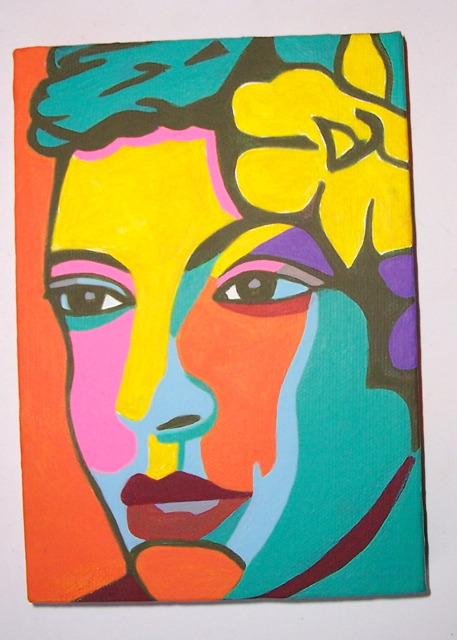
Jessica Shiffman holds up a portrait of herself that one of her student's drew

On Wednesday, August 12, the class was finishing up their shadow boxes that would tell the goblin-human-fire story with two endings. Sophie was rolling out small pieces of clay to make bricks for a house in her shadow box.

She planned to use them again later to make a clay animation video, she said.

The brightly colored clay is called, “model magic,” and it’s made by Crayola. It soft, and pliable like clay, but less brittle and easier to work with. Next to the clay images of goblins and humans are dialog boxes of what’s being said or what’s going on in the scene.

Construction paper, glue, feathers, and clay. Simple materials to tell a story.

One student builds a house made out of construction paper and tape

The next day, Jessica and the students were going to share their progress with the rest of the school at “Share Pad.”

“We only have a few minutes to show what we’re doing,” Jessica said. “They won’t be able to see everything, but just get a jist of it.”

She said that the parents would be able to see the shadow boxes up close later.

No rest for the wicked, or the imaginable. On Friday, the Comics class was going to hollow out gourds that they’ll later use to make puppets. Jessica and her artist husband, Bill, went to Fallbrook last weekend and picked out 12 gourds.

“We have to soak them and scrape off the skin,” Jessica said.

Next week, the class will learn how to make gourd puppets.

“We didn’t start out making gourd puppets in Comic class,” Jessica explained. “I was actually thinking of turning it into another summer class. But the kids liked it so much that we kept it as part of the curriculum.”

The Comics class runs from 9 a.m. to 4 p.m. for two weeks. The students get a lunch break, and snack breaks, but they often work right through them, Jessica said.
Max, one of the students, wrote his name in comic-style letters

To warm up each day, the students do traditional drawing exercises. Yesterday, they did gesture drawings, or 60-second pose drawings of each other. Gesture drawings get students to look at bodily poses.

The previous day, the exercise was portraits. They each drew each other, and Matthew drew a portrait of Jessica.

“See? This is what I look like,” Jessica said, as she held up a portrait of herself.

Max, age 13, from Palm Springs, had completed his shadow box was doodling on paper in a far corner. He had written his name in block letters using black and silver markers. On the wall next to him is faded graffiti. Max doesn’t consider that art.

“All they’re doing is writing their names,” Max said. “It’s not art, but vandalism.”

Yet, his name in block letters resembles the tagger’s style. Where it all came from, you’ll have to look up in the history of comic books.

Connor illustrates one of his comics for class

Connor, who was rolling out some clay, had to rewrite the word, “dos,” meaning, “two” in Spanish for the second ending to their story. It looked too much like the word, “dog,” Jessica warned.

Jessica couldn’t stop talking about how imaginative all of her  students were, even the quiet ones like Matthew.

“In one of his stories, the earth ends, to stop global warming,” Jessica explained. “It eats up all the people, but spits out the wildlife.”

In another one, in honor of Friday, August 13th, Matthew created a comic about a flying burrito that caused a large hole in a woman’s stomach. When one surgeon refused to treat her, she climbed to the top of a flagpole and got stuck (because of the hole in her stomach).

All of this from 11 to 13-year-olds.

Copyright 2010 Idyllwild Me. All rights reserved.

All student’s artwork and stories are copyrighted to the students who created them. All rights reserved.

Custom Search

Nash’s Rock ‘n’ Roll Photo Exhibit a Hit

Saturday, July 24th, 2010

Eric Metzler gives instructions to students before entering MOPA

Baby Boomers are going to love this photography exhibit.

Imagine seeing candid photos all of your favorite rock ‘n’ roll bands with their “hair down,” and vunerable waiting backstage, and then see their sweaty, electric performances close-up like you’d never see them before. Or, catch them after the concerts, exhausted and numb “zoning” on the bus or back in their hotel rooms.

“Taking Aim: Unforgettable Rock ‘n’ Roll Photographs Selected by Graham Nash,” is the current exhibit at the Museum of Photographic Arts in Balboa Park in San Diego. The show continues until Sept. 26.

“There isn’t a bad picture in the bunch,” said Eric Metzler, head of the Photography Department at Idyllwild Arts. He falls into the Baby Boomer category, but he took a group of 10 teenage photography students to see the show on Tuesday, July 20.

For many reasons, taking photographs of the exhibit was not allowed.

There were more than 100 mostly black-and-white photographs, as seen through the eyes of 40 legendary photographers including Lynn Goldsmith, Annie Leibovitz, Henry Diltz, Jim Marshall, Neal Preston, Mick Rock, and Graham Nash, among others.

“What was neat about this exhibit was there were photographers that I had never heard of before,” said Metzler, who has been teaching photography for more than two decades.

Many of the standout photos of this “Take Aim” exhibit were taken by lesser-known photographers, like Alfred Wertheimer, Joel Bernstein, Bob Gruen, Lew Allen, Anton Corbijn, and Jurgen Vollmer.

In fact, the exhibit’s “showcase” photo of Elvis eating breakfast at the Jefferson Hotel in Richmond, VA, was taken by Werthheimer. The photo shows a close-up of a young Elvis, hair slicked back, blazer on, eating bacon and eggs. Elvis’ eyes are downcast, more interested in the meal, than posing for a photo. He looked like an angel eating breakfast.

According to the web site, the photos in this exhibit depict Graham Nash’s view of rock ‘n’ roll music, and showcase images of live concerts and behind-the-scene shots by The Beatles, Elvis Presley, Janis Joplin, Elvis Costello, Elton John, Jimi Hendrix, and Bill Haley & the Comets, among many others.

We knew that Graham Nash, from Crosby, Stills and Nash, could sing, but who knew that he could also take pictures?

“You can get many great shots when people don’t know that you’re really taking their image,” said Graham Nash, a quote that was printed on the wall of the exhibit.

Summer students said they enjoyed the exhibit

Metzler admitted that the “Take Aim” content would appeal mostly to Baby Boomers.  Most of the rock ‘n’ roll groups were from the fifties, sixties, and seventies. But he said that he saw photos from bands from 2003 that would appeal to a younger audience.

Part of the summer students’ assignment was to examine one photograph for clarity, depth of field, composition, and other aspects of good photography, and write their opinions on it. After 30 minutes of looking them over, each student selected a different photograph.

Most of the ones that I liked had mostly to do with rock ‘n’ roll history. For example, a memorable photo of John Lenon and Yoko Ono, taken by Annie Liebowitz, depicts their relationship. It features Yoko, fully clothed, lying on the floor of their NYC apartment, hair spread out like the Venus di Milo. By contrast, John is totally nude, kissing and clinging to her like a baby possum.Yet, what most people don’t know (until this exhibit), is that this photo was taken only a few hours before John Lenon was shot to death.

MOPA wouldn't allow any photos to be taken of their current "Take Aim" exhibit

Nash and his curator did a nice job of grouping photos. For example, they placed a photo of Bob Dylan’s hands just below a photo of Johnny Lee Hooker’s hands. Johnny Lee’s hands were open, palms up, depicting many lines, or a hard road. In one of Bob Dylan’s hands was a lit cigarette, nearly down to the butt. His nails were long, especially the ring finger on his right hand. The left hand was turned over, nonexpressive.

Nash also coupled two photos of Janis Joplin, one by the well-known Jim Marshall, while the other by the lesser-known Elliott Landy. Marshall’s photo depicts a young Janis backstage, all dressed up, yet still defiant. On her lap rests a full bottle of Southern Comfort.

Landy’s photo shows a close-up of Janis Joplin onstage, singing into a microphone. Her hair is frizzed, her eyes are closed, and her right breast has fallen out of her beaded top. Although Marshall’s photo shows a vunerably, Landy’s depiction of Joplin onstage is personal and a bit vunerable too. She is so caught up in the song, that she’s unaware of her “wardrobe malfunction.”

Although there was a couple of photos of Cass Elliot from the 60s vocal group, The Mamas & the Papas, photos of John Phillips was noticeably absent. Perhaps Nash didn’t want to stir up negative feelings after John’s actor daughter, Mackenzie Phillips, recently came out with her incest book. For my part, I was glad not to see him grinning.

Of all the stage antics in these “Take Aim” photos, the ones I liked the best were of Elton John doing a handstand on the piano keyboard, while his platform shoes were flying in the air, and the one of Bill Haley (of Bill Haley & the Comets) playing guitar, while his bass player was standing on top of his bass while playing.

MOPA is located in Balboa Park, the site of many museums and attractions

“Taking Aim: Unforgettable Rock ‘n’ Roll Photographs Selected by Graham Nash,” will continue at the Museum of Photographic Arts until Sept. 26.

The museum is open Tuesday-Sunday. 10 a.m. to 5 p.m., but it’s closed on Mondays. For more information, call (619) 238-7559 or visit www.mopa.org.

Metler’s class will also showcase their photos that they’ve taken over the past two weeks today from 10 a.m. to 11 a.m. at Studio D on the Idyllwild Arts campus. For more information, call (951) 659-2171.

Custom Search

Spending the Summer at Idyllwild Arts

Monday, July 19th, 2010
A

(from L) Kim Christensen and Annie Gutierrez have taken three art classes so far

At Idyllwild Arts, some people are taking one, two, and three art classes, and practically spending their entire summer here. But they wouldn’t have it any other way. Annie Gutierrez, a retiree from El Centro, and Kim Christensen, a teacher from Highland, have already taken three classes so far, and may sign up for more.

“It’s been a great summer,” said Kim, who has already taken two jewelry-focused classes, “Tool Making & Alterations,” and “Navajo Inlay Jewelry,” and is currently enrolled in another, “Soldering Boot Camp.”

Back in Highland, Kim belongs to a group that makes rocks into jewelry.Yet, they were limited in their tools. When Kim brought back a few tools that she created at Idyllwild Arts, her friends were impressed.

“The best tool that we learned to make helps with stamps,” Kim said. She wasn’t talking about the kind of stamps that you put on an envelope or help you make Christmas wrapping paper. “These stamps help you put an image into metal.”

Kim's Navajo bracelet shows stones on one side, and animal stamps on another

She showed off her bracelet that she made in her “Navajo Inlay” class. It was silver, and about 1/2 inch thick, with square turquoise and blue stones on one side, and two ancient animal shapes on the other.

Richard Tsosie, a Navajo jeweler and sculptor from Flagstaff, who taught the class, would show them how to do something, but they’d have to finish the piece on their own, Kim said.

She’s also enjoying “Soldering Boot Camp,” in which they use tools with a flame to connect pieces of jewelry together. According to the brochure, the purpose of the course is not to complete one piece, but to become proficient in soldering.

Annie Guiterrez has been coming to Idyllwild Arts Summer Program for many years. She is a quiet woman in her 70s, who was wearing a T-shirt that read: “My Next Husband is Going to be Normal.”

So far, she as taken “Folding Clay Slabs,” and “Mosiacs 101 & Portraits,” and is currently enrolled in “Creative Nonfiction.” But after a class she took last year, she experienced censorship.

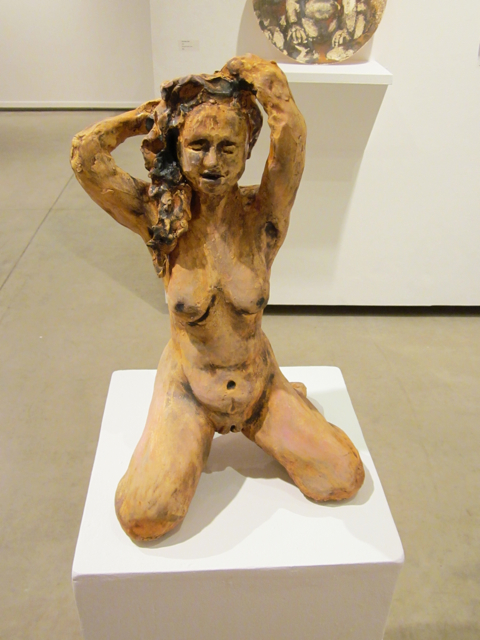
She took the class from Cynthia Constantino called, “Figurative Sculpture,” in which they worked from a live model to create ceramic sculptures. Afterwards, Annie entered her sculpture in the Imperial County Fair and won first prize.

But then they told her, “No, you can’t leave it here.”

“It was a 2 1/2 foot clay sculpture of a nude woman,” explained Annie. “But so is the Venus de Milo. What was the big deal?”

After much discussion between the judges, they told her that she could keep the blue ribbon and the $30 prize money, but she’d have to take her sculpture home right away.

“It was pure censorship,” Annie said. “But El Centro is pretty conservative.”

Many adults in Southern California are spending their summer at Idyllwild Arts

“Folding Clay Slabs,” was one of the first classes that Annie took this summer, and the most enjoyable so far. It was a six-day class taught by Mary Kay Botkins, from East Dundee, IL, who exhibits her folded clay pieces nationally.

“Do you sew?” Annie asked. “Well, I do, and somehow Mary Kay had incorporated sewing techniques, such as pleats and darts, into clay.”

She taught Annie and the rest of the class to roll their clay super thin, about 1/8 of an inch thick, by compressing it.

“That was probably the hardest thing to learn how to do, but when the clay is compressed, it’s pretty strong,” Annie said.

Then, she’d watch Mary Kay create a container, by making a couple of pleats, or adding a waistband, or even a belt loop.

“When she was working, you’d swear that she was working with leather instead of clay,” Annie said.

The students in the class were also expected to be prolific, Annie said, because Mary Kay wanted them to take home a “set” that they could use as a reference. Within six days, Annie created a cup, a vase, a tray and a container.

“It’s something I’ve never seen before,” she said.

For a copy of the Idyllwild Arts Summer Program catalog, stop by the Boman Center on campus, call (951) 659-2171, ext. 2365, or visit the main website, www.idyllwildarts. org, and click on “Summer.”

Custom Search

Sculpture Appears Overnight in Idyllwild

Thursday, July 15th, 2010

A new public art sculpture appeared in Idyllwild on Wednesday night

In the cover of darkness, the four of them unloaded it from the truck. The sculpture was over six feet tall, weighed 250 pounds, and was awkward to maneuver to the ground.

“It was supposed to be four young guys doing the dirty work,” said Steve Moulton, owner of Bubba’s Books. “But it was just me, Dore (Capitani), and another 40ish friend of his. A young passerby stopped and put down his beer to help us.”

All of this was for the love of public art.

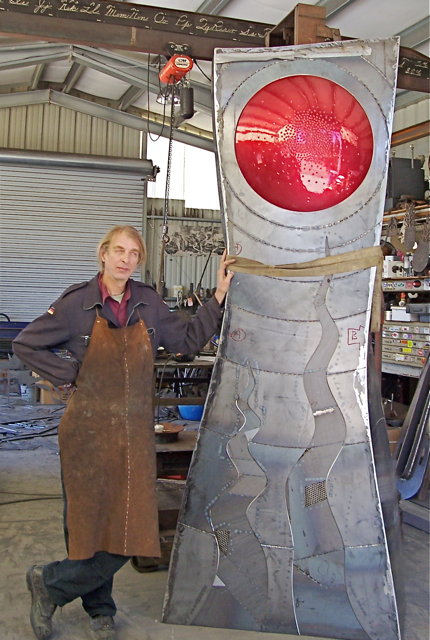
At 8:30 p.m. on Wednesday night, July 14, Idyllwild received another public art piece by Dore Capitani, a metal sculptor from Dore’s Mountain Metals, in Mountain Center.

This sculpture was the second of a series of public art sculptures promised to the people of Idyllwild by the Chamber of Commerce. The first one, depicting a young girl reading a book, is placed at the site of the former tree monument. It was also created by Capitani.

The first public art piece promotes children's literacy and is placed at the site of the former tree monument

“I purchased that one for Idyllwild,” admitted Moulton. “And it’s not just a young girl, it’s Mary, Doug Austin’s wife, who passed away.”

On Mary’s sculpture, it states that it’s dedicated to children’s literacy. There’s also text written in other languages, but the book that Mary is reading is a classic, “Great Expectations.”

Moulton and Capitani met because they’re both Chamber members.

“I went to ask Dore to renew his Chamber membership,” said Moulton. “And the next thing I know, I’m unloading a 250-pound sculpture from a truck at night.”

The new sculpture sits in front of Mountain Footwear in the Fort on North Circle Drive. Richard, who owns it, agreed to host the sculpture on his property.

“Richard was supposed to be here too, but he forgot,” Moulton quipped.

Moulton is concerned that the half sphere will invite kids to hang on it

The new sculpture depicts one of Capitani’s “signature” spheres suspended in the middle of a large, rusted metal shape that slants a little to the left. The sphere is powder-coated vibrant red (a new technique).

But the sphere is not complete, and that’s what concerns Moulton. He thinks that the half sphere will be an “invitation” for kids to hang on it, and perhaps break it. Capitani, who’d like to sell the piece he calls, “P1″ is also concerned about vandalism.

More than likely, it will be used as another “photo op” for visitors to Idyllwild.

At the sculpture site, there isn’t any description of “P1″ or information about the artist, although it’s signed “Dore” at the bottom, if you look for it.

Capitani leaves it up to each viewer interpret his art as he or she sees fit. Whatever it represents, it’s an attractive and welcome site to Idyllwild, “One of America’s 100 Best Art Towns.”

Custom Search

A Tribute to Indian Artist Michael Kabotie

Sunday, July 4th, 2010

Chloe Della Costa shows off a suede jacket with a Michael Kabotie design

All any artist can ever hope for is that their images will live on, inspiring others, long after they’re gone.

The suede and wool jacket was in a blue garment bag hanging over a chair at the Dorothy Ramon Learning Center in Banning, California.

“This must be it,” said the volunteer. “But I cannot believe that someone would leave it here while we’re painting the building.”

Inside, was a jacket made of soft brown suede with gnarly white sheep’s wool lining. Hanging next to it was a shoulder bag made of the same material. But the design on the outside was the most amazing. It showed bold lines and strong characters, things that are held dear and sacred to the Hopi Indians.

“It’s a design created by Michael Kabotie,” said the volunteer. “And someone else put the image on the jacket and bag.”

Kabotie's designs are featured on the suede jacket and shoulder bag

The suede jacket and shoulder bag were going to be on display next Sunday, during a tribute to the Hopi Indian painter, poet, silversmith and philosopher who taught at Idyllwild Arts for 26 years.

According to news reports, Michael Kabotie, 67, died Friday, Oct. 23, 2009, at Flagstaff Medical Center after battling the H1N1 flu and associated complications.

He was from the village of Shungopavi, located on Second Mesa on the Hopi reservation, but had also lived many years in Flagstaff and New Mexico.

He created many beautiful works of art, among them murals at Sunset Crater and the Museum of Northern Arizona, and a gate he designed to look like a piece of overlay jewelry at the Heard Museum in Phoenix.

According to his web site, Michael Kabotie was born in 1942 on the Hopi Indian Reservation in northeastern Arizona. He grew up in Shungopavi and graduated from Haskell Indian School in Kansas. In his junior year there, he was invited to spend the summer at the Southwest Indian Art Project at the University of Arizona, where he met  Joe Hererra, who became a lifelong friend and mentor.

Michael studied engineering at the University of Arizona, but left to hold a one-man show at the Heard Museum in Phoenix. His work was featured on the cover of Arizona Highways magazine.

An Idyllwild Arts invitation to the Native American Arts Festival features one of Kabotie's paintings

In 1967, Michael underwent his Hopi manhood initiation into the Wuwutsim Society and was given the Hopi name, “Lomawywesa,” which means, “walking in harmony.”

Both Michael and his father, Fred Kabotie, have been innovators in the Native American

Fine Arts Movement, creating paintings that reflect traditional Hopi life in contemporary media. Fred was one of the Hopi artists responsible for developing the trademark overlay methods used by many Hopi silver and goldsmiths today. He is also the painter of the “Desert View Watchtower” murals in the Grand Canyon.

In his silver work, Michael used the overlay technique developed by his father and friends, but in his own jewelry, he developed a unique style of his own that is also reflected in his paintings. In 1973, Michael was a founding member of “Artist Hopid,” a group of painters who experimented in fresh interpretations of traditional Hopi art forms.

Michael’s works appear in several museums around the world, from the Heard Museum in Phoenix to the British Museum of Mankind in London, England, and the Gallery Calumet-Neuzzinger in Germany.

His book of poetry, “Migration Tears,” was published in 1987 by UCLA. Michael has lectured across America, in Germany, Switzerland and New Zealand, and has taught Hopi overlay techniques at Idyllwild Arts for many years.

To honor him, Idyllwild Arts will host a “Tribute to Michael Kabotie,” on Sunday, July 11, with a pottery trunk show, with discussions by his son, Paul, and other family members.

The tribute kicks off the weeklong “Native American Arts Festival” at Idyllwild Arts that includes Native American performances, lectures, films and pottery demonstrations. According to the invitation, the festival will explore topics that were of particular interest to this extraordinary artist and teacher: the trickster concept, the artist’s journey, healing and recovery, music and chanting traditions, and cross-cultural dialogue.

Moreover, you will see Michael Kabotie’s images all summer long at Idyllwild Arts. The T-shirts worn by the Summer Program staff, counselors and students features a bright pink Hopi image similar to the one featured on the suede jacket.

The tribute to Michael Kabotie and the Native American Arts Festival events are free and open to the public. For more information, call Idyllwild Arts at (951) 659-2171, extension 2365, or visit www.idyllwildarts.org, and hit “Summer.” 

Custom Search

‘Colorful’ Locals Make Up the Parade

Friday, July 2nd, 2010

Local belly dancer Raye De Ross will be in Idyllwild's Parade Saturday

Besides the horses, marching bands and floats, they’ll be plenty of “colorful” locals in this Saturday’s Independence Day Parade in Idyllwild, including Raye De Ross, and her belly dancing troupe, “The Outskirts.”

Raye’s the front desk secretary-receptionist for Idyllwild Arts Academy, but also teaches belly dancing classes once a week at The Chakra Shack.

“The Out-Skirts” belly dancing troupe is made up of her friends and customers, namely Sherry Cheney, Dakota Bailey, and her mother (who begged not to be identified for this article.)

“I have to live in this town!” she exclaimed.

She also insisted that she be covered in black from head to toe, including a veil for her face, that only exposes her eyes.

“If no one knows who I am, I can be free to have a little fun,” she said.

“Then we’ll have to put a lot of eye makeup on you, and put a bindi on your forehead,” De Ross said.

She is dressing the rest of them in colorful outfits with veils that cover their faces, long skirts that show off their waists, and belts that “chime” as they move.

Colleen is part of a belly dancing troupe called "The Outskirts"

De Ross started belly dancing 16 years ago, when her then-5-year-old daughter, Colleen, exclaimed that she wanted to take lessons. They were living in Seattle at the time, and had just watched an international belly dancing competition on TV.”

“It’s a misconception that belly dancing is erotic dancing,” said De Ross, who encouraged both of her pre-teen girls to take lessons. “It was originally created by women for women.”

She said belly dancing builds self esteem in young women and in larger women like her, who often don’t feel coordinated and pretty.

“Belly dancing is embracing our sacred feminine,” she said.

De Ross and “The Out-Skirts” plan to be walking more than dancing in the parade, however.

“Anyone who has been to a parade knows there’s a lot of standing around, waiting for everyone to catch up,” she said. “But, this year, we’re behind the jeeps.”

Like other parade participants, De Ross will be handing out candy and maybe some business cards to the crowd. She hopes to drum up more clients for her $10 lessons on Tuesdays at The Chakra Shack.

Idyllwild Independence Day Parade begins at 10 a.m. on Saturday, July 3rd, at the top of North Circle Drive, then winds down to the center of town. For more information, call the Idyllwild Rotary at (951) 659-4957. For belly dancing lessons by Raye De Ross, call The Chakra Shack at (951) 659-3191.

Custom Search

‘Metals Week’ at IA Starts June 27

Sunday, June 27th, 2010

Jewelry designer & teacher Kristin Coffin

Jewelry designer and teacher Kristin Coffin and her boyfriend, Lewis, loaded up the last of their valuables from their studio apartment near the Jewelry District in LA. The rest of their stuff they were storing at a friend’s house. This is what they’d been waiting for: Summer Camp at Idyllwild Arts.

Kristin was going to teach jewelry making to children, and Lewis, a graphic designer, would be a counselor for nearly three months in Idyllwild.

Kristin came to Idyllwild Arts Summer Program two years ago in response to an advertisement online. Like most teachers they attract, Kristin is an accomplished professional. She graduated Summa Cum Laude from the University of Vermont with a BA in metalsmithing and jewelry design. She was the goldsmith at the couture gallery, Grannis Gallery, one of the premier art jewelry galleries on the east coast. Currently, she is the metalsmith for Belle Brooke Designs in Los Angeles.

There, she admitted to unusual sales tactics.

“We’d go to lunch and always wear the jewelry from the store,” Kristin said. “But we’d leave the tag out on purpose. Women would always tell us about the tag, and we’d start a conversation about the necklace.”

Los Angeles is great, but she likes the slower pace of Idyllwild.

Teachers like Kristen Coffin like coming to small town Idyllwild

“I love it here,” she said, as they headed toward the San Jacinto Mountains. “I’m a small town girl, and Idyllwild reminds me of home.”

This winter, however, she spent a lot of time in the hi-rise buildings of LA’s  Jewelry District.

“It’s bigger than the one in New York City,” Kristin said. “Each of the shops in these hi-rises has a specialty, such as diamonds only four carats and up.”

She said that only those in the jewelry business could shop there, however, and because shop keepers are showing precious jewels, gold and silver, everyone had to be “buzzed” inside.

There, she bought pliers and other tools for her classes, and jewels and materials for her own jewelry that she describes as “organic.”

“It’s kind of feminine use gems only as accent pieces,” Kristin explained. “I use mostly silver and gold, and sometimes blacken the silver, so it creates a nice contrast to the gold.”

For a jewelry maker and teacher, she wears no jewelry at all.

“I used to wear a lot of jewelry, but I’m working in the shop all the time, so it doesn’t make sense to wear it when I’m forging,” she said.

‘METALS WEEK’ KICKS OFF SUMMER PROGRAM

Many social activities are planned on campus during "Metals Week"

Speaking of forging, it happens to be the focus of one of the classes during “Metals Week” at Idyllwild Arts that starts today, Sunday, June 27, and runs until Thursday, July 1st.

According to the catalog, “Metals Week” is a week of intensive metals studies in which adult students can work with one of six outstanding jewelers and metalsmiths.

“Everyone comes here to learn a skill, such as etching, trapping, sculpting or tool making,” explained Kristin, who is helping out another teacher this week. “It doesn’t make sense for everyone in the class to do one project. You can do that anywhere.”

“Forging Collars, Pendants and Sildes,” is a class taught by Fred Zweig,who has been a metalsmith and teacher for more than 30 years. For the first part of the weeklong class, adult students will take a heavy sterling silver gauge rod and create a stylish neck collar. Then the rest of the time will be spent designing and creating slides and pendants that will hang from the collar.

Other classes that make up “Metals Week” include: “Resin Inlay,” by Karen Christians from Waltham, MA; “Etching,” by Deborah E. Love Jemmott from San Diego, CA; “Sculpted Bezels & Non-Traditional Stone Settings,” by Pauline Warg from Scarborough, ME; and “Trapping Found Objects,” by Joanna Gollberg from Ashville, NC;  and “Tool Making & Alterations,” by Val Link from Houston, TX.

Tuition for all of these classes are $655 plus a lab fee that ranges from $35 to $85, that includes using the school’s tools and equipment. All are limited to 12 adult students.

“Although ‘Metals Week’ classes begin today, we’ll still take walk-ins late,” said Emma Showalter, Assistant Director of the Summer Arts Program. “We will accommodate anyone who wants to come to the classes.”

Idyllwild Arts has a plethora of activities for students during “Metals Week,” including a faculty lecture and slide show tonight at 7 p.m. at the Krone Library; an arts exhibition, hot clay lecture and opening reception at 7 p.m. on Monday at the Parks Exhibition Center; a potluck dinner and auction on Wednesday, June 30 at Studio D and a student exhibition on Thursday, July 1, on the Krone Library’s patio.

For more information on classes and activities for “Metals Week” at Idyllwild Arts, call the registrar at (951) 659-2171, extension 2365; fax (951) 659-4552 or visit the web site at www.idyllwildarts.org, and click on “summer session.”

Custom Search

Bird Houses for the Boys

Tuesday, June 15th, 2010

Resident Peter Hopper shows off his birdhouse "mansion"

Outside his Idyllwild home every weekend, Peter Hopper sets out tables, hardware shelves, beach umbrellas and the American flag. On display are his homemade bird houses, including single dwelling, three-room “condos,” and one unique gingerbread “mega mansion.” Stacked off to the side are flower boxes with flowers or geometrical designs on them. And around the corner is a massive bird feeder mounted on a nine-foot pole.

Although these are the work of a master craftsman, it more of his “calling card,” and an opportunity to teach his two young boys about his old world craft.

Hopper's bird houses include an Abe Lincoln log house style

“These bird houses are a friendly way to get to know people,” said Hopper, who has lived with his family in Idyllwild since 2000.

Hopper, is tall, clean-shaven (including his head), and speaks with a heavy Austrian accent. Although he looks like “Mr. Clean,” he is soft spoken and philosophical, especially when talking about his family.

“I’m working with my boys on weekends trying to teach them carpentry–like I learned from my father in 1976,” Hopper said.

“Idyllwild is a great place to be because there’s nature all around, not lots of traffic and people are friendly,” he added.

Behind him in the open garage are a plethora of table saws, drills, a planer and boxes of tools. Sawdust is all over the floor and tables.

Hopper uses a hand held saw to carve the designs onto the flower boxes

“As a carpenter, you need high quality equipment,” Hopper said. He mainly does commercial work that includes installing of hardwood floors, marble and porcelain tiles, restoration of antique furniture, and plumbing that includes sprinkler and drip systems.

One of his recent jobs in Idyllwild was on Country Club in which he built several small decks, and an ornate brick entryway. He’d like to do more local work, so he wouldn’t have to commute to Oceanside.

In the meantime, however, he’s content to teach his boys about carpentry on weekends.

His son, Liam, age 15, helps him create the bird houses and flower boxes, while Dylan, age 9, is the salesman. Dylan’s homemade sign reveals the prices: $35 for the single-dwelling bird houses, $45 for the stacked, three-room condos, $180 for the gingerbread mega mansion, and $85 for the bird feeder.

“Dylan doesn’t like the sawdust, so we made him the salesman,” Hopper explains. “He’s great at selling, but doesn’t always understand adult humor. Like when a customer offered to pay for a bird house with a credit card, Dylan was left speechless.”

“We lost the sale, but Dylan knows next time to tease them right back,” Hopper added. “We told him to say, ‘No, we don’t accept credit cards, but we’ll take your cash or a check.’”

All of the bird houses have a standard-sized opening, but Hopper will custom fit them with a smaller wooden insert, if you’d like. Bluebirds, for example, need smaller holes, to keep the larger bluejays out.

There are a variety of styles

There are primarily two styles Hopper sells, a plain one with a slanted roof, and a modified log cabin style (to match many of the homes in Idyllwild). The “condo,” bird house, coined by Dylan, has three rooms.

He created that style when he had seen a tree at his sister-in-law’s place that housed as many as 50 birds.

“Some birds are more social,” he said. “So you can mount two of these condos side-by-side on the tree and make a lot of birds happy.”

However, his latest bird house, the “mega mansion” (also coined by Dylan), shows off Hopper’s carpentry skills. There is great detail in the pitched roof with double chimneys, and the wrap-around porch. It looks like a gingerbread home you’d might find in Austria.

It takes some time for he and the boys to create this masterpiece, so the price is reasonable at $180. They sold two of them last year, with one customer mounting it on a pole, while the other hung it from a tree.

Although ornate, there is no paint or waterproof coating on the mansion–and the other bird houses as well. Hopper said that most of his customers prefer to paint, seal or decorate them themselves.

The flower boxes come in a variety of design styles

However, the flower boxes are decorated, stained and sealed with a waterproof coating.

The designs include flowers, geometric patterns, and more recently, children’s cartoon faces. Hopper pencils in the design on the box to start, then carves them with a hand-held router. Then he sands it off and finishes with a wood stain and a polyurethene coating.

You may have seen his handiwork outside the beauty shop in town, the Help Center, and Strawberry Creek Inn.  Adding a name to the flower box costs $15 more.

“People come to me with newspaper clippings and drawings, and ask me to duplicate the design,” Hopper said. “We are happy to accommodate  everyone.”

The flower box dimensions are approximately 33 inches long, by 8 3/4 inches wide and 7 1/2 inches high. Hopper recommends inserting plastic liners into the boxes so that there is protection between the dirt and wood. The liner also serves another purpose.

“At night, you can easily pick up the liner and bring your flowers into the house,” said Kelly, his wife. ” That way, you’ll keep them from freezing, or bothered by animals.”

Adding color to the flower boxes was his wife, Kelly's idea

It was also her idea to add color to the flowers on the flower boxes.

“We’re always looking for ways to improve,” she said.

The bird feeder that sits in front of their house is remarkable. It has a large roof to protect against rain and snow, with a large opening for several birds to feed at once. There is about a one-inch rim around the bottom to keep the seeds or peanuts inside.

Like the bird houses, Hopper recommends that people use a plastic liner for easy inserting and cleanup.

Worm's eye view of Hopper's $85 custom made bird feeder

It costs $85, but you can also purchase a nine-foot pole for $10 that can be mounted into a pipe into the ground. Some need help installing the bird feeder, and Hopper helps them for free.

It’s all about teaching, family togetherness, and not so much about the money. He doesn’t have to say it. His sales speak for themselves.

Last year, Hopper and his sons sold about 15 bird houses, and 25 flower boxes, but gave 50 of them away, mostly to schools and children.

He knows that he could beef up sales by opening up a shop in town, or selling online on eBay. None of these options appeals to him right now.

“My family is number one. Here, I have all of my tools and my boys to help me,” Hopper said. “If I have to make 100 bird houses, then it becomes work, and not so much fun.”

He’s been through all that, he said, 30 years ago when he worked 2o-hour days for someone else. Now, he’s just happy to do custom work and making a few bird houses with his boys.

To see the Hopper family bird houses, visit them at 53675 Tollgate Road in Idyllwild, or call (951) 659-5909.

Custom Search

‘Inquire’ Student Art Show

Tuesday, May 25th, 2010

Will Waddell, a teacher at Idyllwild Arts, views Angelica's sculpture

“Inquire, Negate & Repeat,” which featured the work of four student artists, were large, clean, and thought-provolking about nature, especially dolphins. The show included sculptures, ceramics, fiber art, paintings, and drawings. It opened at the Parks Exhibition Center at 6 p.m. on Friday, May 21, and will run until May 28.

The show’s title, “Inquire, Negate & Repeat,” came from a meditation, said Jade, one of the artists. The others included Anna, Angelica and Karina.

Ceramics by Anna entitled, "States of Mind" covered one wall

“Anna is the ceramics guru of our department,” said one student.

It was easy to see why they were in awe. Anna’s ceramics were outstanding. As you walked into the show, and looked to the left, there were a variety of her ceramic “flowers,” in variable dimensions with mirrors inside, all mounted to the wall. The arrangement was called, “Frames of Mind.”

“That would make a great statement in your home’s entryway,” said one Idyllwild resident.

Anna had four other equally outstanding ceramic pieces, including a large ceramic basket, with dainty flowers nestled inside. The piece also had fine wires for stems, and a rope edge to the basket.

Three other ceramic pieces by Anna were maddenly entitled, “Untitled.”

“I don’t know if artists don’t like to title their work, or if they just forgot,” said another art student later. “The titles should really help you understand the pieces, especially if the artist isn’t there to help explain things.”

The top of the larger “Untitled” ceramic by Anna (on the shelf) had a top that resembled a leafy vegetable. Like the flowers in the other flower basket, they appeared live, and not ceramic.

"Untitled" ceramic by Anna looked organic

“People 2010,” was Anna’s final ceramic installation, which resembled a chessboard full of kings and rooks. Or, a closed city made up only of castles with no surrounding countryside.

The finish on the “People 2010″ pieces were crackled, or antique looking with neutral glazes.

“Angelica, your work is some of the best I’ve seen here,” said Samuel, a voice major in the school van later.

Angelica’s sculptures and ceramic painting were large, clean and thought-provolking.

The first thing everyone saw was the mixed media sculpture on the floor entitled, “Separation of Ego,” which had a deer’s head at the front, a woman’s torso with a maroon portrait painted on its chest, and a woman’s legs pointing upward at the back. Each of these sections was separated by panes of glass.

"The Glass Bead Game," a ceramic painting, by Angelica

The woman’s portrait on the torso of “Separation of Ego,” also appeared in her ceramic painting on the wall entitled, “The Glass Bead Game,” and in the alabaster sculpture, “The Shower.”

“It looks like a self portrait, but they could be different,” said Miriam-Grace, another visual artist, later. “I saw her working on it from a photograph.”

The ceramic portrait was sectioned off into squares, that looked like ceramic tiles. Attached in random places were ceramic flowers, in a pretty glaze.

Angelica’s final piece, a sculpture called, “The Shower,” was created in alabaster. The face was delicately carved, but the torso was left rough and unfinished. Its smooth and roughness beckoned people to touch it.

Wayne Parker inspects "The Shower" sculpture by Angelica

If you were to squint, the rough parts could be considered soap suds in a shower.

“I got a chance to carve a little bit on it,” added Miriam-Grace. “It’s not particularly a soft stone, but you have to be careful. There are many cracks inside, and pieces can come off in chunks.”

The show then switched from hard to soft sculpture with Jade’s “Knit Up in Sleep Performance,” a 24-foot black and white acrylic yarn sculpture that was draped over a black wire chair.

Jade's 24-foot yarn sculpture was slated to expand further

The title car read, “24 feet and expanding,” which gave the impression that she wasn’t finished yet. The balls of yarn left under the chair were also a good indication that she might finish it over the summer.

Along the wall next to the yarn sculpture were black and white ink drawings, all uniform in size, yet organic in subject matter. Some looked like amoebas or pieces of yarn under a microscope. They were all mounted to four large boards and entitled, “864-Static.”

As much as I like titles to pieces, “864-Static,” didn’t help me one bit. Was the number an equation? It certainly was more than the 100 or so drawings mounted to the boards. Was it an apartment number? Or the number of strokes from her pen?

Karina’s “Herd” installation, “Swarm” print, “Flock/Pod” drawing and “Burnt Ball” acrylic painting all had a focus on nature.

Luckily, she was still around talking to friends towards the end of the show. She said that  the 100 or so small antelope looking pieces were made of resin.

“I took a mold (of a plastic buck) and filled it with resin,” Karina explained. “As you can see, some of them turned out better than others.”

All were arranged in a swirling, migration formation, from right to left, and mounted on a light box.

Karina's "Herd" installation was made of resin pieces placed on a light box

“The light box was the hardest part to make,” Karina confessed. ”I wanted to resemble a herd migration, like something that you’d see on the Nature Channel.”

Side by side on the far wall were two tall pieces, one a painting, the other a drawing on vellum. The drawing, “Flock/Pods,” showed a creative ariel view of birds (a flock) in flight over pods of dolphins swimming in the ocean.

Logistically, she put the flocks on vellum, as an overlay, to the drawing of the many dolphin pods underneath. Although only created in black graphite, the drawings were strong and solid. Her ariel view you could only see in a helicopter or plane. It was a God’s eye view.

It’s sister painting, created in bright acrylics, “Burnt Ball,” gave me pause. It was also an ariel view of a sun overlooking dolphin pods in the ocean. Although beautiful, something about it was unsettling. Karina and all of the other patrons had gone, and I was left alone with “Burnt Ball,” and my unsettling thoughts about dolphins and the Academy Award-winning documentary, “The Cove.”

Having an inquiring mind about animals, I wished Karina’s “Burnt Ball” was a statement about the depleting dolphin population in Taiji, Japan.

I had seen a viewing in Idyllwild at Movie Night at the Green Cafe (see Idyllwild Me blog post from March 30).

Karina's "Burnt Ball" reminded me of the dolphin demise depicted in "The Cove"

“Director Louie Psihoyos took home this year’s Oscar for Best Documentary for his stunning heist-like story that is about half Jacques Cousteau and half James Bond,” said Jeffrey Taylor, who showed “The Cove.” “A ‘dream team” of activists venture to Japan to expose the secretive work of a small community of fishermen who slaughter dolphins so they can sell the meat nationally and abroad.”

Richard O’Barry, who rose to popularity with “Flipper,” the popular TV show in the 1960s, said that he became an activist when one of the dolphins committed suicide right in front of his eyes.

“The next week, I was sitting in a jail cell for letting captive dolphins go,” O’Barry said in “The Cove.”

O’Barry collaborated with Psihoyos in creating “The Cove,” to get the word out of the massive dolphin slayings that are held each year from September to March in Japan. In a small cove in Taiji, fishermen herd dolphins in from the sea by forming a line of boats and making noises with metal poles. The process is known as “oikomi.”

“Dolphins are keenly sensitive to noise,” O’Barry said in the movie. “They are afraid of the noise and swim to the cove to get away from it. There, they are herded into nets and the bottle nosed dolphins like the ones in “Flipper” are sent to marine parks like “Sea World,” while the other dolphins are brutally slaughtered.

Many Japanese do not know that this is going on, and would likely not approve of it. In the documentary, tests prove that dolphin meat has toxic mercury levels, and is not good for human consumption. In fact, in the May 10th issue of the Japan Times, the National Institute of Minamata Disease (NIMD) stated that many Taiji residents as having unusually high levels of mercury. Taiji, where they have a tradition of eating whale and dolphin meat.

However, the more “inquiring minds”  know, the better the chances of stopping it. For more information, Google “The Cove,” visit www.takepart.com, or text the word DOLPHIN to 44144.

Custom Search

Crash Sculpture Causes a Stir

Saturday, May 22nd, 2010

Dore's crashed motorcycle sculpture is grabbing a lot of attention

Someone once said, “Artists are the first and last to speak.”

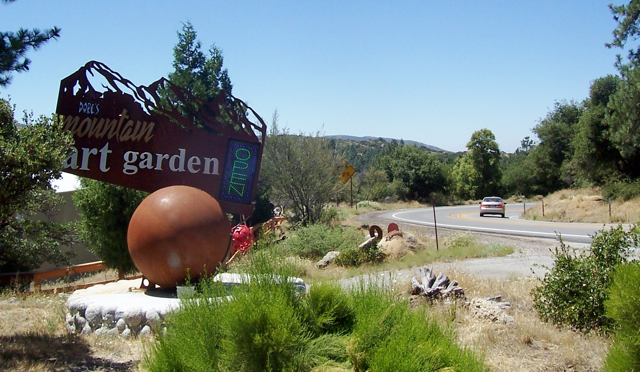
Well, one artist in Mountain Center is speaking out about the current state of traffic around his metal sculpture garden.

There’s too many motorcycle accidents happening there, he said.

About two years ago, CalTrans, along with a contractor, attempted to fix the curve on the road from Mountain Center leading up to Idyllwild. They widened the road and added caution stripping to the middle, but many accidents still happen there.

“They fixed the road, so people think they can go faster now,” said Dore Capitani, a metal sculptor whose shop sits at the end of the curve. He closes his eyes and sighs. He’s seen his share of motorcycle accidents.

One time, he said, the motorcycle flew right onto his property, near his metal building where he was working.

“The guy fell off it earlier, but the motorcycle came pretty fast around the curve and landed on my property,” Capitani said.

After a motorcycle flew into his yard, Dore put up a wooden barrier

After that, he wasn’t taking any chances. With the help of Josh Whitney, who owns a tree cutting business in Idyllwild, they stacked up several huge wooden tree trunks that act as a barrier to his property. It kept the motorcycles from coming in, but didn’t stop the accidents from happening.

So last week, Capitani decided to put up a life-sized metal sculpture of a crashed motorcycle and attach it to the wooden tree stumps.

“I had an old junker motorcycle, and about three wheels laying around,” Capitani said. “So I made a crash sculpture.”

Well, some Idyllwild townsfolk and at least one CHP officer thought it was real, and became alarmed.

Some motorcyclists told Dore that they didn't like the sculpture

“One police officer came over the wood pile looking for the body,” Capitani said. “These guys are used to fighting crime, but he couldn’t see that the motorcycle was welded to the wood!”

“Then Larry from the hardware store said that I better add something to the sculpture because people were concerned,” Capitani added. “So I added the word, ‘OUCH!’”

“Ouch!” is welded next to the motorcycle in bright, red letters, so there’s no more confusion. But there’s still bad feelings.

He said that several motorcyclists have stopped by his art garden and said they weren’t happy with his sculpture.

“They don’t have to like it,” Capitani said.

He hopes that it might make a few motorcyclists and drivers stop and think about going too fast on that curve. It’s clearly marked “25 mph” on either end, but most of them go 50 mph.

One CHP officer, who was assigned up in Idyllwild for years, grew weary of the motorcycle accidents. When he was writing up a report about one, he asked the kid how fast he was going. The kid, who had a broken leg, didn’t lie.

“I was going 50 mph,” he said.

“It’s marked 35 mph,” the officer scolded. “That means 35 mph, not 36, not 37, but 35 mph.”

That motorcyclist was lucky that he only sustained a leg injury, but his bike was “totalled.”

Dore's art garden has many more sculptures to see

Capitani’s motorcycle crash sculpture is located just after the curve in Mountain Center at 28815 Hwy. 243. Visit Dore’s Mountain Metals Sculpture Garden for other large metal and wood sculptures made by him or call (951) 659-0791.

Custom Search